Test the idea before the big commitment.
Validate Your Business Idea
A seven-day research sprint for checking the problem, speaking to potential customers and choosing the next small test.
Free complete workbook · 14-page fillable PDF · No signup
Related reading: Founders & Business · Included in membership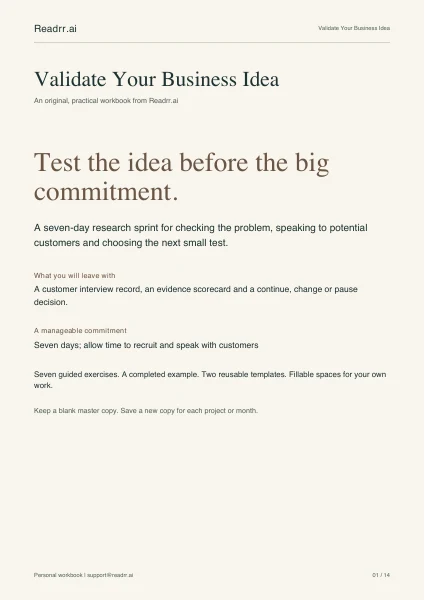 The library is opening…
Leave with something
you can use.
A customer interview record, an evidence scorecard and a continue, change or pause decision.
For first-time founders and side-project builders deciding whether an idea deserves more time and money.
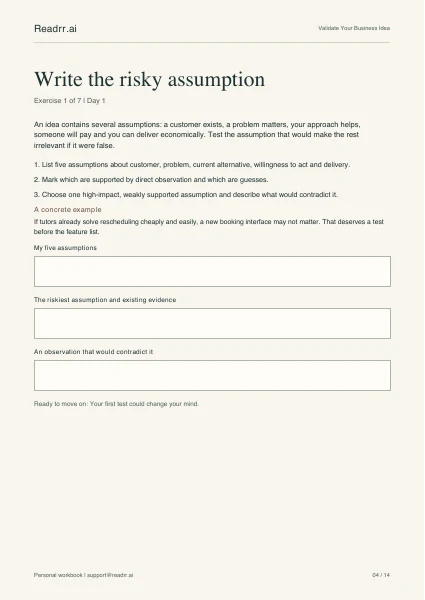
Actual workbook page · first exercise
A clear path
through the task.
- Write the risky assumption
- Recruit for relevance
- Ask about the last time
- Keep an evidence record
- Test a smaller commitment
- Check the delivery reality
- Decide: continue, change or pause
- A completed example to follow
- Your customer interview script
- Your evidence scorecard
- 32 fillable spaces for your own work
Time to allow: Seven days; allow time to recruit and speak with customers.
Try the first
exercise. Free.
No email needed. Read the instructions, then make a first attempt below.
Your answers stay in this page and are not submitted to Readrr. Download your notes before leaving.
Write the risky assumption
An idea contains several assumptions: a customer exists, a problem matters, your approach helps, someone will pay and you can deliver economically. Test the assumption that would make the rest irrelevant if it were false.
- List five assumptions about customer, problem, current alternative, willingness to act and delivery.
- Mark which are supported by direct observation and which are guesses.
- Choose one high-impact, weakly supported assumption and describe what would contradict it.
Example. If tutors already solve rescheduling cheaply and easily, a new booking interface may not matter. That deserves a test before the feature list.
Choose the next test with more context.
Use the evidence record from your toolkit to decide whether you need a clearer assumption, a different experiment or more customer learning.
Inside Founders & Business
These independent reading companions are included in Readrr membership.
- 1
Which assumption matters most?
Running Lean
Put the riskiest assumptions in order before building more.
Keep in view: A completed planning canvas is still a set of hypotheses.
Find it in the reading list - 2
What would make a useful test?
Testing Business Ideas
Consider an experiment that can produce evidence about one assumption.
Keep in view: Different experiments provide different strengths of evidence.
Find it in the reading list - 3
How will I keep learning?
Continuous Discovery Habits
Explore how customer learning can continue as you revise the idea.
Keep in view: Interviews need thoughtful recruitment and do not establish willingness to pay by themselves.
Find it in the reading list
Compare the perspectives.
Running Lean helps map assumptions. Testing Business Ideas helps choose an experiment. Continuous Discovery Habits considers learning as the product changes. A plan, a conversation and a buying commitment provide different kinds of evidence.
Bring it back to your worksheet.
Return to your evidence scorecard: choose one uncertain assumption, define an observable next action and set a review date before committing more time or money.
A suggested reading route from Readrr. The toolkit remains free. All five interactive collections and Workspace are included for $9/month, $99 once for 12 months, or $199 for lifetime access. Original books are not included.
Make a start.
Keep the tools.
A customer interview record, an evidence scorecard and a continue, change or pause decision.
A small research sprint reduces some uncertainty; it cannot prove market demand or guarantee a viable business.
Validate Your Business Idea
FreeThe complete workbook. Yours to use.
14-page fillable PDF. Seven exercises. One completed example. Two reusable templates.
Download the complete PDFDownload instantly. No email address, account or payment required. Save a copy before adding your answers.